


Microsoft killed the Courier tablet concept in favor of Windows 8 tablets, but the idea behind it has now found a new home, as an iPad app. After four months of reviewing the app, Apple approved Taposé, an app that mimics the functionality seen in the concept videos for the now defunct Microsoft Courier tablet project.
Microsoft did not develop the $2.99 app. It was created by two Seattle developers, Benjamin Monnig and Ricky Drake, with Kickstarter funding. They also had support from J Allard, the leader of the Courier project at Microsoft, who left the company shortly after the concept was axed.
Delivering the Courier Dream
Taposé will look familiar to those who have watched the Courier concept videos, otherwise, the app brings an entirely new way to interact with your iPad. The app works best in landscape mode, where you are presented with two side-by-side windows that can accommodate one of five modules. These include Journals (a notebook), a Web browser, maps, contacts or a calculator.
A menu bar divides the two modules, which also allows you to select between several tools to create content in the journals. You can also drag the bar laterally so you can see in full screen either the right- or the left-side module. By dragging the bar up, you reveal the menu, where you can simply drag into a panel a new tool you would like to use.
The journals module is where you can collate your work -- you can make cutouts from Web pages, record audio, use the hand writing tool (with your finger or a third-party stylus), type text, add images and videos or maps. You can also select from various paper stocks for the journal, and keep different notepads for various tasks. Journals can then be exported via e-mail, Dropbox and Evernote, and the app comes with 400MB of free cloud storage ($30 per year for unlimited sharing and collaboration with other app users).
If you use your iPad more for business purposes than just reading, browsing the Web or watching videos, Taposé is definitely worth a go. The dual-panel interface can spare you a lot of going back and forth with the iOS multitasking bar, when you can simply drag elements from one side of the screen to the other. The first version of the app lack handwriting recognition though, and the graphics are not optimized for the Retina display.
Follow Daniel Ionescu and Today @ PCWorld on Twitter
source:http://www.pcworld.com/article/252754/microsofts_axed_courier_tablet_concept_reborn_as_ipad_app.html

Apple's latest iPad has been on sale less than a week and--following the usual round of rave reviews from critics--the company looks headed for controversy as complaints and criticisms mount about Apple's newest tablet.
So far three reported problems are vying to be the top controversy for the third-generation iPad but, in the end, there can be only one to cause the same media commotion as past Apple-gates such as Antennagate, Locationgate, and Batterygate.
So which will it be? Let's take a look at how Heatgate, Wi-Fi-gate, and Videogate score on the "-Gate" Probability Index.*
[RELATED: iTunes Appears to Change Colors of Images Sent to the New iPad]
The most publicized contender so far is Heatgate. This is an issue that started with the Dutch site Tweakers, but really caught fire with a new claim by Consumer Reports--the same magazine that pushed Apple to respond to Antennagate.
Consumer Reports recently said that, in its tests, the new iPad hits temperatures as high as 116 degrees Fahrenheit when running games. To put that number in perspective, 116 degrees is reportedly hot enough to destroy enzymes in food or act as a natural spermicide for men. But all may not be as it seems as, towards the bottom of its post, Consumer Reports says this: "at its hottest, [the iPad] felt very warm but not especially uncomfortable if held for a brief period."
Gate Probability: 50%
Videogate
It turns out that if you stream a lot of video using the iPad's new 4G connectivity, you will burn up the cap on your monthly data plan in no time. A recent report by The Wall Street Journal tells the story of one Brandon Wells who after streaming March Madness basketball for two hours discovered he'd used his entire 2 gigabyte monthly allotment from Verizon.
The problem, the Journal says, is that LTE connections tend to use more data than 3G usage even when delivering the same information, so those faster speeds come at the expense of higher data usage. And if you're thinking about streaming a high-definition movie over LTE, don't. The Journal reports that watching an HD movie over LTE requires 2 gigabytes per hour on Verizon.
Gate Probability: 65%
Wi-Fi Gate
If your new iPad is giving you the LTE blues, and you're hoping to find more Wi-Fi connections when you're out and about, you may be in for a surprise. Users are complaining on an Apple forum that the iPad (third generation) often drops or has problems connecting to Wi-Fi.
"My shiny new iPad arrived on Friday...it's about as much use as a chocolate fireguard. wifi only works when i'm within 6 ft of my router," complained one user on Apple's forums. "A bit frustrated that $877 later and I have a subpar new pad," said another new iPad owner. Apple may have to release a software update to fix this issue, but until then it sounds like we have a winner.
Gate Probability: 90%
(*A given issue's "-gate" score is based on a specially-developed probability algorithm involving a finger, saliva, and wind.)
Any other issues about the new iPad dogging you? Let us know in the comments.
Connect with Ian Paul (@ianpaul) on Twitter and Google+, and with Today@PCWorld on Twitter for the latest tech news and analysis.
See more like this: apple ipad
http://www.pcworld.com/article/252282/top_3_controversies_hounding_apples_newest_ipad.html

Apple’s next version of the iPad will feature 4G LTE connectivity on both Verizon Wireless and AT&T, according to a Wall Street Journal report. The device, dubbed the iPad 3, is expected to be unveiled March 7 and may come with a higher-resolution display and a quad-core chip.
Apple is quiet as usual on the new iteration of the iPad, but next month the iPad 2 will be one year old and an updated version is expected from the company. Last year, the iPad 2 was launched on March 2. It has since sold more than 43 million, maintaining Apple’s position as market leader despite a flurry of rival Android tablets.
Details about the iPad 3 are very thin yet pundits seem to have reached a consensus on a core set of improvements for the new tablet. A high-resolution Retina Display is hot-tipped for the iPad 3, doubling the current iPad's resolution to 2048-by-1536. While production has reportedly begun for the display, some argue the improved screen could make the iPad 3 slightly thicker -- though it would be unusual of Apple to launch a new product that’s thicker than the older version.
A quad-core chip is on the cards for the iPad 3, says the iMore website. Dubbed A6, the quad-core system-on-a-chip would have twice the power of the dual-core A5 found in the iPad 2 and iPhone 4S, and would be powerful enough to drive the above-mentioned Retina Display. Apple has introduced new chips with each iteration of the iPad, chips that have later found their way to the latest iPhone.
If the reports are accurate, Apple would be in keeping with the strategy it has deployed with new iPhones and iPads. The Retina Display in the iPhone would finally make its way across the line to the iPads, and the company would also make the long-anticipated jump to 4G technology, widely adopted by now by high-end Android devices.
What appears to have been holding back Apple from adoption 4G LTE by now is battery life with the technology, as Android rivals are widely documented to suffer from poor battery performance. It’s unclear though whether Apple will make the jump to 4G and manage to keep the same 10-hour battery life for the iPad 3, and later down the line, a 4G iPhone with battery life comparable to earlier models.
source:http://www.pcworld.com/article/249923/ipad_3_expected_to_have_4g_connectivity.html
A source is claiming that the iPad 3 will be announced on March 7. That date is a Wednesday this year which that particular day of the week falls in line with other product announcements by Apple. That week also falls inline with earlier reports just a few days ago from another source.
So, on March 7 this year we should hear more about the iPad 3 and perhaps be given a release date of the week after earliest.

The rumours of what will be included have more or less been the same such as a Retina display with a resolution of 2048x1536 pixels. Also an Apple A6 quad-core chip was also mentioned although some believe Apple wont go for quad-core but will instead, choose another dual-core with far better performance than the A5. A new rumour hints at 4G being included although with 4G there's still battery life to consider. It might be too early for that to arrive in this model. Expect it to be a "world iPad" though with both CDMA and GSM versions combined in to the single unit.
Nobody out of Apple will know for sure what the new iPad will have, but it's fairly easy to predict that the specs will be bettered this time around which means the higher res screen, faster CPU and better cameras are likely. We don't expect to see anything too radical though.

The latest build comes from CyanogenMod 9 and with it a number of fixes have been included. This time around, the Kindle Fire has working audio. Prior to the update there were a number of problems with it. On the downside, video playback is still a little sketchy.
To get the new update working, you can follow the instructions over on XDA developers (linked above). Installation is relatively simple if you follow step by step. Make sure that you follow all warnings.
Also, Liliputing points out that gApps will need a reinstall due to the update wiping the old version out.
source:http://www.gadgetvenue.com/android-ice-cream-sandwich-for-kindle-fire-gets-more-bug-fixes-01205455/

Amazon has reported that sales of the Amazon Kindle range of devices has tripled over the holiday season. Although Amazon do not report on specifics such as the amount of devices sold, they do comment that sales went extremely well.
“We are grateful to the millions of customers who purchased the Kindle Fire and Kindle e-reader devices this holiday season, making Kindle our bestselling product across both the U.S. and Europe,” said Jeff Bezos, founder and CEO of Amazon.com. “Our millions of third-party sellers had a tremendous holiday season with 65% unit growth and now represent 36% of total units sold.”
Although Amazon had strong sales of the device, the main money is made from the content sold on those devices. Amazon works to very tight margins to keep the devices cheap and then makes up for it from the books, movies and other content that users buy. Some Kindles are also support by ads which also makes those a little cheaper to buy.
Rather than re-quote all the numbers from the earnings reported, take a look at TFTS that has posted a summary of the numbers.
We are unsure of the future of the Amazon Kindle Fire although rumours hint at a new version launching soon, perhaps with a same sized screen or possibly one closer to the size of the iPad. Amazon appears to have done well with the smaller 7 inch screen approach so they might continue along with what works rather than trying something they are unsure of.
source:http://www.gadgetvenue.com/amazon-reports-triple-sales-of-the-kindle-during-holiday-season-02013502/

Not all upcoming quad core tablets made it to CES 2012, so here’s one that surfaced after the big event in Las Vegas: Fujitstu Stylistic M532. We’re dealing here with a quad core Nvidia Tegra 3 slate with Android 4.0 on board and a pretty reasonable 499 euro price tag. The device runs Android 3.2 in the video below, but at launch time it will be equipped with ICS.
This model is 10.1 incher with 1280 x 800 pixel resolution, 16GB of internal memory, a SIM card slot and an 8 megapixel camera. There’s also a 3 megapixel camera upfront and we’re expecting a May debut here. The guys of Techfokus, who took this gizmo for a test drive say that it’s very smooth and fluid when it comes to interaction. No idea if this model will reach the USA or not, but considering Fujitsu’s recent passion for the States, I’d say it will.
This is probably the fourth or fifth quad core tablet I’ve seen this year and not even a month has passed. This trend is really starting to catch on, if you ask me… And now let’s see HTC and Samsung unveiling quad core units!
SOURCE:http://tablet-news.com/2012/01/18/fujitsu-stylistic-m532-tegra-3-tablet-unveiled-after-ces/
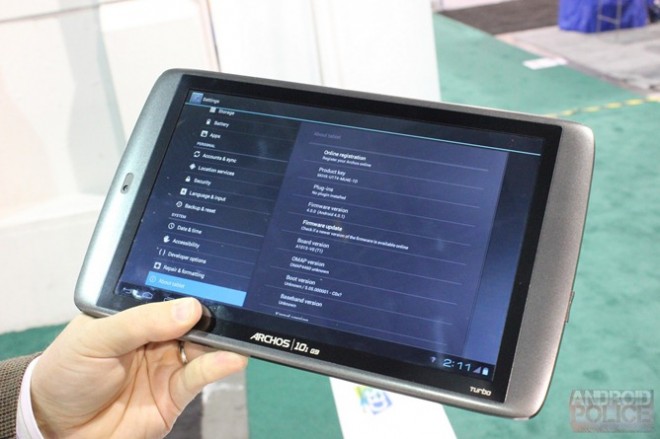
ASUS has stayed true to its promise to upgrade the Transformer Prime to Android 4.0 and they even did that two days earlier than they promised, so now it’s the turn of other companies to follow in this trend. One of them is Archos, that announced plans to upgrade all of the G9 series tablets to Ice Cream Sandwich by the first week of February.
This piece of news came at CES where Archos was also present (South Hall in the showrooms). This means that after February you might start buying Archos G9 tablets with ICS already installed. The picture above shows one such unit running Android 4.0.1, but keep in mind that the version coming in the following weeks is 4.0.3. In case you’re not familiar with these tablets, one of them is the Archos 80 G9, that features an 8 inch display, a 1GHz processor and 16GB of storage, but it’s available in many versions with even more storage and some with a more powerful CPU.
Prices range from $299 to $369 for this product. Then there’s the Archos 101 G9, with 10.1 inch 1280 x 800 display, a 1.5GHz processor and a price tag of $399 for the 16GB unit. Tempted?
SOURCE:http://tablet-news.com/2012/01/13/archos-g9-tablets-to-get-android-ice-cream-sandwich-upgrades-in-the-following-weeks/

Research In Motion didn’t unveil any new devices at the Consumer Electronics Show this year, but the Waterloo, Ontario-based vendor still managed to appease fans with a preview of its first major PlayBook OS update that will finally be released some time next month. We spent a good amount of time putting the OS 2.0 through the paces and while there are still some kinks to iron out — we had apps crash on us a number of times — we absolutely walked away impressed. Check out our hands-on photos in the gallery below and hit the break for our impressions.
PlayBook owners have been waiting for what seems like an eternity for RIM to finally bring native PIM functionality to the PlayBook, but the wait was worth it. We were already fans of RIM’s tablet, but the addition of in-built email, calendar and contacts without the need to tether to a BlackBerry smartphone is obviously a welcome addition. RIM did a great job with the apps as well, providing what is easily among the best email and calendar experiences we’ve seen on a tablet. Apps integrate with each other seamlessly and we’re big fans of the layered UI RIM used in the email app.
The email app opens to reveal a unified inbox with a list of messages on the left, and the body of highlighted messages appears to the right. Interactions with the menu buttons on the far left beyond the message list reveal a new panel on which users can perform searches, apply view filters, drill down to individual accounts and more. The calendar and contacts apps function much the same way, with layers of panels that slide to the right as the user selects menu items.
Integration across apps is also well-designed. For example, contacts are tied to meeting entries in the calendar. In the day view, a panel opens up to the right that displays a complete list of all contacts the user is scheduled to interact with over the course of the day. If changes to a meeting need to me made, the user can quickly and easily call or message contacts scheduled to attend the meeting and notify them of the changes. The PIM functions in PlayBook OS 2.0 support the standard mix of email services along with LinkedIn and Twitter right now, but more integration with various social services is coming.
While BlackBerry Bridge is no longer needed for email, calendar or contacts, RIM has added some great new functionality that we will be showing off in a forthcoming video walkthrough. Most notable is the new remote control feature, which allows users to type, navigate and even perform gestures on a PlayBook using a BlackBerry smartphone.
Even with all its improvements, the PlayBook OS is still missing key elements — most notably, support for two features RIM is well known for are still missing: BES corporate email support and BBM. The absence of this core functionality makes the PlayBook 2.0 still feel like an incomplete solution, but from what we know so far, RIM is working hard to overcome the development obstacles we have detailed numerous times here on BGR. As it stands now, assuming RIM works out the stability issues we saw, PlayBook owners should absolutely be happy with the PIM features and other new functionality coming to the PlayBook next month.
Last paragraph updated to clarify a lack of BES email support in PlayBook OS 2.0. Other BES features are supported by RIM’s BlackBerry Mobile Fusion solution.
SOURCE:http://www.bgr.com/2012/01/11/blackberry-playbook-2-0-hands-on/

According to Korea's Electronic Times Internet News, it's been confirmed that Samsung Electronics and LG Display will supply LCD panels for Apple's iPad 3, which is scheduled to be unveiled as early as in Q1 this year.
Sharp was originally known to be developing display panels, but reportedly failed in initial supply.
This same report goes on to state that "Sharp has competed with Samsung Electronics and LG Display over the development of display panels for the iPad 3, but reportedly failed to pass Apple's approval process for mass production. Sharp has worked on developing high resolution panels on the basis of oxide semiconductor TFTs."
In a report that we posted on December thirtieth, it was being rumored by DigiTimes that their sources believed that Apple was going to replace their IPS displays with those using IGZO technology from Sharp. Today's news doesn't necessarily contradict the rumor if Apple and Sharp are working on a future generation HDTV.
Yet as far as Sharp Electronics being an official iPad 3 display supplier for at least the first half of 2012 is concerned, it now appears to be in doubt.
According to ETN's industry sources, Apple plans to procure at least 65 million LCD panels for the iPad 3 this year. The quantities of LCD panels supplied by Samsung Electronics and LG Display in Q1 are estimated to be over 5 million LCD panels to meet the demands of the initial iPad 3 launch.
SOURCE:http://www.patentlyapple.com/patently-apple/2012/01/sharp-is-reportedly-out-of-the-race-for-ipad-3-display-production.html
Orange plans to introduce its own brand tablet for the UK market. The mobile operator has partnered with Huawei, the Chinese manufacturing firm, to produce Tahiti, a 7 inch super stylish and sleek Android based tablet available for £69.99 on a plan of £25 every month.

The device, which looks like a rebranded version of Huawei Mediapad device, runs on Google's Android 3.2 Honeycomb operating system and is powered by dual-core 1.2GHz Qualcomm processor. Available in slate silver and black finish, it comes with a multi-touch LCD screen.
It also has a 5 mega pixel camera along with WiFi, A-GPS, 3G+ connectivity and Bluetooth facilities. As the device is very light at just 390 grams, it provides great portability. The high powered procession along with the Honeycomb OS surfing Internet as well as watching movies on the device while on the move is easy and effortless, reports Tracy and Matt.
The device is available for £25 a month for a 24 month data plan and is has 1GB anytime data offer, 1GB "quite time" data and also unlimited accessibility to WiFi hotspots every month. This is very exciting for Orange subscribers.
